


What are the fabric printing methods and which printing technology is suitable for fibers?
Do you also print on fabric? Or maybe you plan to do it? Choosing one of the fabric printing methods can be difficult, but if the effect, quality and durability of printing are important to you, I suggest you read the rest of the article.
Table of Contents
1.Choose the right method for printing your fabric
2.Rotary printing
3.Cylindrical printing
4.Stencil/screen printing
5.Thermal printing/transfer/sublimation
6.Reactive digital printing
7.Conclusion
8.Proposal
1. Choose the right method for printing your fabric
At first, you should ask yourself what your fabric is and depending on it, choose the right print. You should determine what fibers your fabric is made of? They often have problems in understanding and choosing the right method of fabric printing, and this factor itself has a great impact on the final result of their work. The success of your project depends on choosing the right printing method, fiber and color type. Since no comprehensive and basic summary of printing types can be found anywhere on the internet, we decided to collect everything for you on the AraChap website. We really hope to make your choice much easier after reading this!
2. Rotary printing
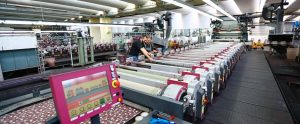
In this machine, before the fabric enters the printing stage, it passes through a series of creasing rollers, lint remover and guide rollers and is ready for printing. The fabric is placed on the blanket. Rotary stencils are cylindrical so that they can print without stopping. The printing paste feeding mechanism in this method is automatic. The printing paste is injected into the stencil by a pump. The printing paste is transferred to the surface of the fabric by a fixed squeegee located in the middle of the stencil. A separate page is required for each color of the design, more complex designs require the use of more colors, and typical rotary presses have a capacity of 20 pages.
benefits :
.Preserve color on fabric
.The possibility of creating quality prints
.Penetration of dye or ink in the fabric
.Can be used for natural, synthetic and mixed fibers
Disadvantages:
.It is not possible to create shadows in designs
.Inability to create delicate designs
.Applicable only for simple images and designs
.Occupying a lot of space and stopping the fabric during printing
.Not suitable for printing several different colors on fabric
.High cost to make stencils in more complex designs
.The need for specialist forces to adjust the rolls on the fabric
3.Cylindrical printing
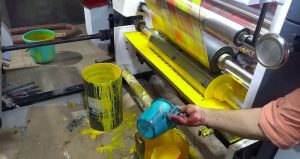
In this type of printing, like rotary printing, rollers are used. With the difference that the rollers on which the design is engraved are passed through a compound and then by a spatula, the extra colors are removed from the highlighted parts and It only remains inside the grooves and finally the color comes off on the fabric.
Advantages:
.Preserve color on fabric
.The possibility of creating quality prints
.Suitable for all types of fibers (natural, synthetic, mixed)
Disadvantages:
.Complex work environment
.Limitation on print circulation
.It is not possible to create shadows in designs
.Low accuracy in printing (it is not possible to print elegant designs)
.Spending high costs to make cylinders in complex designs
4. Silk printing
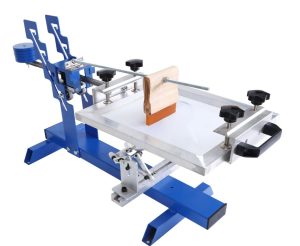
In this method, lace fabric with very small holes is used. The net is fixed in a frame, then the desired image is engraved on this net. The parts of the image that should not be colored are covered with a blocking material, and this net frame is called a stencil or stereotype in this case. In the next step, the color is pressed. We move the spatula or roller to the printed surface. The dye is only transferred from the unblocked areas to the fabric or surface to be printed and the image appears on it. Commonly used in art, design, and manufacturing to create repetitive patterns, logos, signs, or product labeling. Silk printing makes it possible to accurately and efficiently repeat designs on different surfaces. With stencils, you can print the same image as many times as you like.
benefits :
.Economically, it is affordable
.Can be used for natural, synthetic and mixed fibers
.The simplicity of this method is perhaps the most important advantage of silk printing
Disadvantages:
.low speed
.Low elegance
.Low resolution
.Low final quality
.Limitation in color
5.Thermal printing/transfer/sublimation
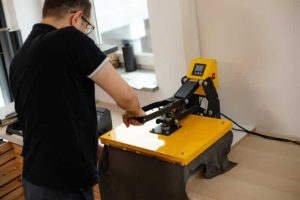
Transfer printing is a two-step process for printing on fabric. This design is transferred from paper to fabric using heat and pressure. First, the artwork is printed with ink on special paper. Second, the design is transferred to the fabric using heat with a heat press. The heat stimulates this special ink to form an adhesive on the opposite side of the special paper, the ink adheres to the fabric, then the paper is peeled off and the design remains. This is an easy process and can take 3 to 5 minutes to make one item. Depending on the quality of the composite, the time and the amount of heat can be adjusted so that the accuracy in the colors is more clear.
benefits :
.High speed
.Occupying little space
.This device is affordable
.Printing is simple and even applicable at home
.A cleaner workspace than other printers
.It is great for printing real photos
.Minimum technical skills required to set up the device
.Can be used for natural, synthetic and mixed fibers
Disadvantages:
.Limit on the number of prints
.Spending a lot of time on top prints
.Ironing is not possible in this print
.Fading images due to continuous washing
.The difficulty of printing for dark clothes
6.Reactive digital printing
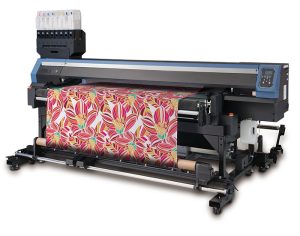
In digital printing on fabric, special measures need to be taken before placing the fabric in the printing machine that works at high speed. The digital fabric printer receives the printable information from the computer and by choosing the correct color, prints the desired design on the fabric with high quality. the device is removed. This type of printing is only for natural fiber fabrics and it is not possible to print for synthetic or even mixed fiber fabrics because in this process the reactive dye that is specific to this printing only reacts with natural fibers.
benefits :
.Light resistant
.Abrasion resistant
.Resistant to washing
.High quality and resolution in printing
.No restrictions on design and color
.Ability to create 3D designs
.The possibility of creating dark and light shadows
.The possibility of creating delicate and delicate designs
.Color creates an inseparable bond with fabric
.No need to spend a lot of money to make cylinders and stencils
Disadvantages:
.Only applies to natural fibers
7.Result:
There are different methods for printing and dyeing fibers. If you intend to print a fabric, first specify the fibers and then (according to your needs) choose the most suitable printing for you using the above information.
8. Proposal
In the field of reactive digital printing on natural fiber fabrics, Arachap Rangin Sepahan company, with a brilliant history, is ready to cooperate with manufacturers, start-ups, fashion houses, brands, etc. Therefore, if you wish to Get more information and free consultation Click here