


Applications of artificial intelligence in the textile industry
What is artificial intelligence (AI)?
(AI) refers to the simulation of human intelligence in intelligent machines. They are programmed to think like humans and imitate their actions. It is a broad branch of computer science that deals with making machines capable of performing tasks that would normally require human intelligence. The term artificial intelligence can also be applied to any machine that exhibits characteristics associated with the human mind, such as learning and problem solving.
Why is artificial intelligence used in the textile industry?
The demand for high quality has increased, and this factor has led to the use of automatic artificial intelligence in the textile industry in recent years. Today, artificial intelligence has become very popular in textile production due to technical advances and the use of modeling and simulation.
Textile industries are becoming more automated to meet the process demands of consumers. The use of artificial intelligence reduces the number of errors and keeps production costs low. AI is used in all stages (pre-production, production and post-production) of textiles.
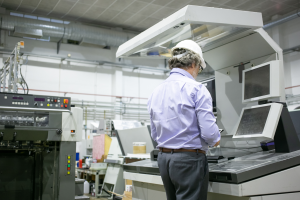
Fabric pattern recognition:
Artificial intelligence can be used to eliminate defects such as: dirt and contamination, weaving errors, tears, finishing and printing defects by using its vision feature. By replacing manual inspection with artificial intelligence, manufacturers can help avoid fatigue and human error in the aforementioned cases. AI techniques such as artificial neural network (ANN) are used to identify defects through pattern recognition in fabric inspection. The image of the fabric to be analyzed is obtained from the collection system and in the form of an image. Then AI starts processing and troubleshooting according to the defined standards.
Fabric development:
In general, fabric inspection is done manually by skilled workers using relevant devices. This process is relatively slow and not free from human error. Hence, this process is vulnerable and in many cases can allow errors to be transmitted to the production side. In this context, the use of AI can do this with higher speed and accuracy and without fatigue. Artificial intelligence can also be used to investigate the comfort characteristics of clothing fabrics. While sensory comfort is considered, fabrics can be classified based on their underhand value using artificial intelligence.Artificial intelligence in fabric printing and dyeing: In this sector too, artificial intelligence has many applications, such as recognizing the color appropriate to the material, its permeability, etc. Color is one of the important aspects of textile products. Consumers and clothing brands choose or reject fashion based on aesthetics, which mostly includes the appeal of color. Therefore, in order to obtain the right color, it is necessary to control the exact quality during dyeing and printing, which can affect the purchasing decisions of consumers and finally the sales volume. Both the dyeing and printing processes must be done correctly. Parameters are influenced by the combination of color, fabric and chemical reactions and interactions governing them.The deviation of these parameters from the allowed limit may lead to reprocessing or cause failure. In this field, the use of artificial intelligence can play a significant role.
Advantages of using artificial intelligence in the textile industry
Let’s explore how AI is impacting the textile industry and how textile businesses can use AI to stay competitive.
1. Optimization of textile production
Artificial intelligence can help textile manufacturers optimize production processes, increase efficiency and reduce costs. Textile factories can use AI-equipped robots to automate repetitive tasks such as material handling and cutting to improve accuracy, leading to higher productivity. They can use artificial intelligence to analyze large amounts of textile production data to optimize production schedules.
2. Automatic scheduling of maintenance
Textile businesses can use sensors and AI-based monitoring systems to predict when equipment is likely to break down and schedule maintenance. This can help reduce downtime and increase productivity. Predictive maintenance allows textile companies to optimize their maintenance schedules, reducing the need for unnecessary maintenance and increasing efficiency.
3. Matching color and dyeing
Artificial intelligence can be used to improve the accuracy and precision of color matching and color formulation. With artificial intelligence, textile companies can identify the ideal color and color combination for a particular product. AI-powered systems can predict color fading and allow color adjustments to be made. This factor reduces waste and costs. Artificial intelligence can also optimize the dyeing process and reduce water and energy consumption.
4. Quality control and defect detection
Sensors, cameras, and algorithms in textile factories with artificial intelligence can improve the accuracy and efficiency of quality control processes. Cameras equipped with artificial intelligence can be used to identify defects such as holes, stains and uneven seams in real time and with a high degree of accuracy. Textile companies can reduce the need for human inspections by using artificial intelligence.
5. Optimizing the supply chain
The use of artificial intelligence in textiles can predict demand, optimize production schedules and manage inventory levels in real time. AI-based systems can identify and mitigate supply chain risks, where potential issues are proactively addressed. AI not only improves efficiency and reduces costs, but also leads to faster time-to-market, better customer service and increased competition.
6. Inventory management
Textile companies can use AI to analyze sales data and predict future demand to make more informed decisions about inventory levels, and reduce the risk of inventory and overstocking. The use of artificial intelligence in textile companies can help identify items and allow them to adjust their inventory and distribution strategies.
7. Helping fabric design
Artificial intelligence can be used to help textile designers create new patterns, textures and designs. They can use ML and generative AI to create new designs faster and more efficiently. It can increase creativity and innovation in textiles. AI-based systems can also be used to analyze consumer preferences, allowing designers to create designs that are more appealing to customers.
8. Market analysis and demand forecast
Artificial intelligence can help analyze textile market trends and make early predictions. By analyzing large amounts of data, such as sales data, consumer preferences, and industry trends, textile companies can gain valuable market insights and make more informed business decisions. Additionally, AI-based systems can be used to predict future market trends, allowing textile companies to proactively adapt to market changes.
9. Energy Management
Artificial intelligence can improve energy management in textile factories by regularly monitoring energy consumption. Artificial intelligence in textile factories can identify areas where energy is wasted and take steps to reduce consumption. By using artificial intelligence, textile companies can reduce energy costs, increase efficiency and minimize their environmental impact. In addition, they can comply with energy regulations and reduce their carbon footprint.
10. Virtual exhibition simulation
Virtual reality and augmented reality technology based on artificial intelligence can be used to create immersive virtual exhibitions. Textile companies can use this technology to display their products to customers in more interactive and attractive ways. Virtual reality can be used to simulate the production process, allowing textile companies to test new ideas and designs.
11. Pattern manipulation
Artificial intelligence can automate the process of creating patterns and reduce the time and costs associated with manual cutting. Systems equipped with artificial intelligence can help to optimize patterns, reduce fabric waste and increase efficiency. The technology can also be used to grade patterns, allowing textile companies to create multiple sizes of the same pattern with minimal adjustments.
12. Fabric classification
Artificial intelligence algorithms can be used to sort fabrics based on color, texture and other characteristics. Textile factories can use this feature when preparing orders for customers so that they do not have to sort them themselves on site or return them if there is an error in the order. This saves time and money for both parties involved in the transaction.
In general, AI has many advantages such as the following:
-Decreasing error percentage
– Increasing product quality
– No need for human resources
– No wastage and reduction of product waste
– The possibility of creating standards
-Increasing production statistics
-Improving automation management
– Easy identification of defects in each part
-And…
Result:
Artificial intelligence system is one of the best choices in textile industry for management, quality, cost, application, just-in-time production and integrated digital production. Artificial intelligence in the textile industry is bringing revolution and leading disruption like never seen before. Artificial intelligence is a promising technology that can change the textile industry for the better, and by using it, textile manufacturers can reduce their costs, increase their productivity and improve their environmental impact. AI can also help textile customers find their ideal products and styles with ease and convenience.

Proposal:
In the field of reactive digital printing on natural fiber fabrics, Arachap Rangin Sepahan company, with a brilliant history and technical knowledge, is ready to cooperate with manufacturers, start-ups, fashion houses, brands, etc. Therefore, if you wish. Click here for more information and a free consultation